Why Florida—Especially Central Florida—Is the Best Place to Fly at Any Experience Level

4
Orlando, FL — Whether you’re a brand-new student pilot, a private pilot building confidence, or an experienced aviator logging cross-country time, one thing is becoming increasingly clear in the aviation world:
👉 Florida—especially Central Florida—is one of the best places in the United States to fly.
With year-round flying weather, diverse terrain, a dense network of airports, and endless destinations within short flight times, pilots across the country are recognizing Florida as a true aviation playground.
At Countrywide Flyers, we see it every day—pilots flying more often, progressing faster, and enjoying aviation at a higher level simply because of where they’re based.
Here’s why Central Florida stands out as one of the most pilot-friendly regions in the country.
🌤️ Year-Round Flying Weather Creates More Opportunities
One of the biggest barriers to staying current in aviation is weather. In many parts of the country, winter conditions can ground pilots for weeks—or even months—at a time.
Florida changes that equation completely.
Central Florida offers:
- Warm temperatures year-round
- Mild winters with consistent flying conditions
- Frequent VFR days
- Early morning calm winds ideal for training
While summer thunderstorms require planning and awareness, they also help pilots develop real-world weather decision-making skills—something that ultimately builds stronger, more capable aviators.
👉 The result: more days in the air and fewer excuses to stay grounded.
🗺️ A Perfect Geographic Layout for Every Type of Pilot
Florida’s geography is uniquely suited for aviation, especially for pilots building experience.
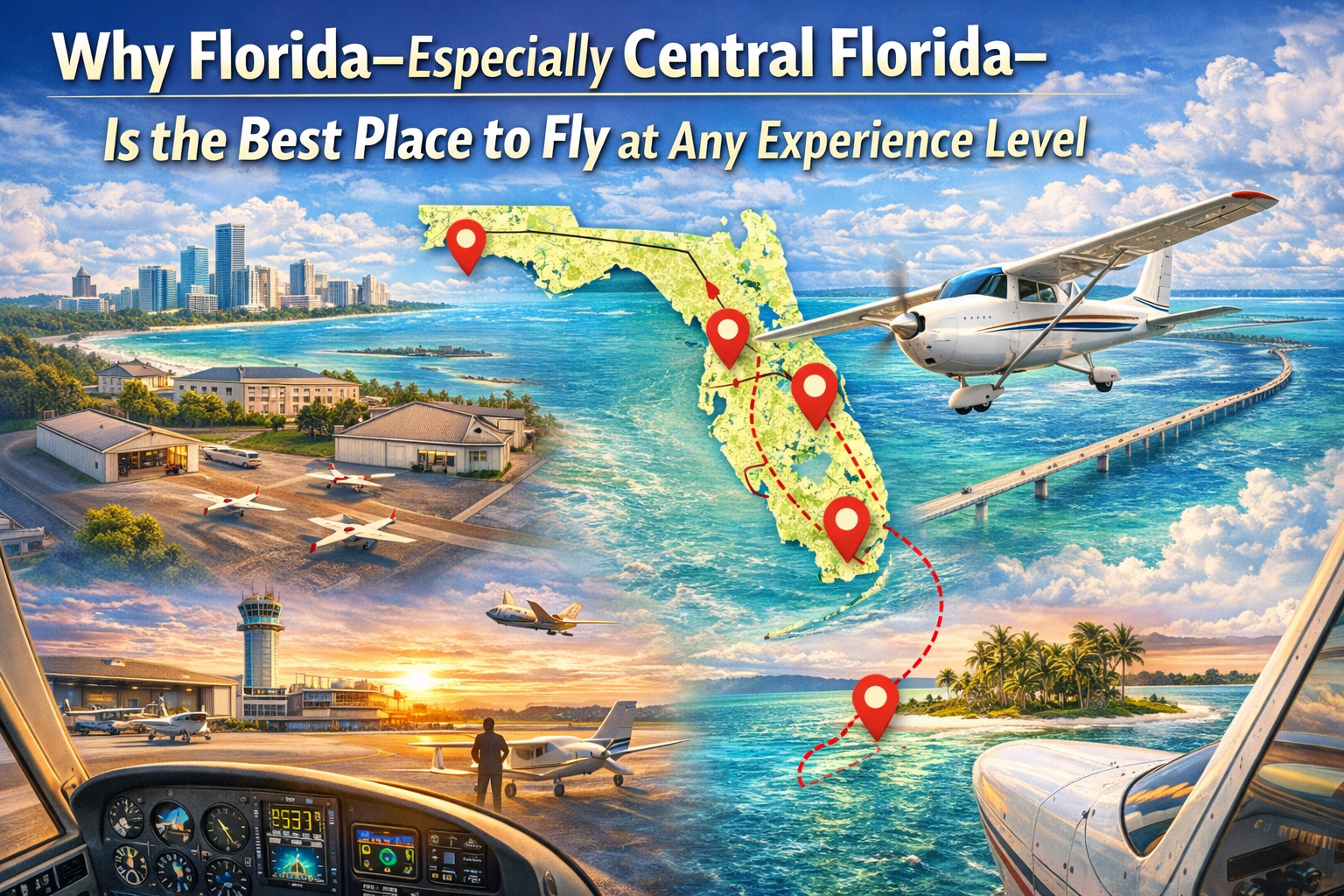
From Central Florida, you can reach:
- The Atlantic Coast in under 30 minutes
- The Gulf Coast in about 45–60 minutes
- North Florida historic cities in about an hour
- South Florida and the Keys within a few hours
This makes it possible to plan:
- Short training flights
- Scenic coastal runs
- Cross-country time-building flights
- Full-day aviation adventures
Unlike mountainous or terrain-heavy regions, Florida’s flat landscape also makes navigation more approachable—especially for newer pilots.
🛫 One of the Densest Airport Networks in the Country
Florida has one of the most pilot-friendly infrastructures in the U.S.
In and around Central Florida alone, pilots have access to:
- Multiple general aviation airports
- Well-maintained runways
- Fuel availability
- Maintenance support
- Flight training resources
From smaller community airports to busier Class B and Class C airspace, pilots can train and operate in a wide range of environments—all within a relatively short distance.
👉 This variety builds confidence, adaptability, and real-world experience faster than many other regions.
🧑✈️ Ideal for Student Pilots and Training
Central Florida is one of the best environments for student pilots to begin their aviation journey.
Why?
Because it offers:
- Predictable weather patterns (especially mornings)
- Flat terrain for easier navigation
- Plenty of nearby airports for cross-country training
- Controlled and uncontrolled airspace exposure
Students can quickly gain experience in:
- Towered airport operations
- Radio communications
- Pattern work
- Navigation and cross-country planning
👉 This accelerates learning and produces more well-rounded pilots.
🛩️ A Playground for Private and Advanced Pilots
For certificated pilots, Florida offers something even more valuable:
👉 Variety.
Within a single day, you can:
- Fly to the beach for lunch
- Land at a historic coastal town
- Explore springs or nature destinations
- Head south for a tropical island experience
- Practice instrument approaches
- Or simply enjoy a sunset flight
This diversity keeps flying exciting and prevents the burnout that many pilots experience in less dynamic regions.
🌴 Endless Destination Flying (The Lifestyle Factor)
One of the biggest reasons pilots fall out of currency is simple:
👉 Flying becomes repetitive.
Central Florida solves that problem.
Instead of:
- Flying laps in the pattern
- Staying local
- Getting bored
Pilots can turn every flight into:
- A destination
- An experience
- A reason to stay current
Popular day trips include:
- Coastal beach runs
- Gulf Coast sunsets
- Historic city explorations
- Springs and nature flights
- Island hopping toward the Keys
When flying becomes something you look forward to—not something you “have to do”—you naturally stay more active and proficient.
👥 A Strong and Growing Aviation Community
Florida has one of the most active general aviation communities in the country.
In Central Florida, that includes:
- Flying clubs
- Flight schools
- Aircraft owners
- Aviation events
- Social flying groups
Being part of a community matters more than most pilots realize.
Pilots who are connected:
- Fly more often
- Stay more current
- Continue learning
- Share knowledge and experiences
👉 Aviation becomes a lifestyle—not just a license.
🚀 Perfect for Flying Clubs and Shared Aircraft Access
The Central Florida environment is especially powerful when combined with a flying club model.
Flying clubs allow pilots to:
- Access aircraft without ownership costs
- Fly more frequently
- Stay engaged with other pilots
- Participate in group trips and events
In a place like Orlando—where destinations are abundant and flying weather is consistent—this model becomes even more effective.
At Countrywide Flyers, we’ve seen firsthand how pilots fly more, build confidence faster, and enjoy aviation more when they have both access and community.
⚖️ Lower Barriers to Staying Current
In many parts of the country, staying current can feel like a chore.
In Florida, it feels natural.
Because:
- Weather supports frequent flying
- Destinations make flights enjoyable
- Airports are accessible
- Aircraft availability is higher
- The community encourages activity
👉 Staying current becomes part of your routine—not a struggle.
🏁 Final Take: Florida Isn’t Just a Place to Fly—It’s a Place to Become a Better Pilot
When you combine:
- Weather
- Geography
- Infrastructure
- Community
- Lifestyle opportunities
…it becomes clear why so many pilots consider Florida—especially Central Florida—the best place to fly.
No matter your experience level:
- Student pilot
- Private pilot
- Instrument pilot
- Commercial pilot
Florida gives you the environment to:
👉 Learn faster
👉 Fly more often
👉 Stay current
👉 Build confidence
👉 Actually enjoy aviation
🚀 About Countrywide Flyers
At Countrywide Flyers, we’re proud to be part of Central Florida’s aviation community—helping pilots of all experience levels access aircraft, build confidence, and enjoy the freedom of flight.
Whether you’re just getting started or getting back into flying, there’s no better place to do it than right here in Central Florida.
Ready to Experience It for Yourself?
Join Countrywide Flyers and discover why Florida is one of the best places in the country to fly.
Frequently Asked Questions About Flying in Florida
✈️ Why is Florida considered one of the best places to fly?
Florida is widely considered one of the best places to fly because of its year-round flying weather, flat terrain, dense network of airports, and diverse flying environments. Pilots can access beaches, cities, islands, and nature destinations within short flight times, making it easy to stay current and enjoy aviation regularly.
🌴 What makes Central Florida ideal for pilots?
Central Florida is uniquely positioned in the middle of the state, allowing pilots to reach both the Atlantic and Gulf coasts quickly. It also offers a wide range of airports, airspace environments, and consistent weather conditions, making it ideal for both training and recreational flying.
🧑✈️ Is Florida a good place for student pilots to learn to fly?
Yes, Florida is one of the best places for student pilots. The flat landscape, frequent VFR weather, and availability of both controlled and uncontrolled airports allow students to gain experience quickly and build strong foundational skills.
🛩️ Can experienced pilots benefit from flying in Florida?
Absolutely. Experienced pilots benefit from Florida’s wide variety of flying opportunities, including cross-country trips, coastal flying, instrument approaches, and diverse airspace. The ability to fly year-round helps pilots stay proficient and continue developing their skills.
🌤️ What is the weather like for flying in Central Florida?
Central Florida offers generally favorable flying conditions year-round. Mornings are often calm and ideal for training flights, while afternoons—especially in summer—may bring thunderstorms. With proper planning, pilots can safely fly frequently throughout the year.
🗺️ How far can you fly from Orlando for a day trip?
From Orlando, pilots can reach:
- The Atlantic Coast in about 20–30 minutes
- The Gulf Coast in about 45–60 minutes
- North Florida destinations in about 1 hour
- South Florida and the Keys in 1.5–3 hours
This makes Orlando one of the best hubs for aviation day trips.
🏖️ What are popular day trips for pilots in Florida?
Popular pilot day trips from Central Florida include:
- Beach flights to Cocoa Beach or Sarasota
- Historic trips to St. Augustine
- Island flights to the Florida Keys
- Nature trips to Crystal River or Ocala
- City trips to Tampa or Miami
These destinations offer a mix of scenery, dining, and unique experiences.
🛫 Are there a lot of airports in Central Florida?
Yes, Central Florida has a very high concentration of general aviation airports. Pilots have access to multiple well-maintained airports with fuel, services, and varying airspace environments, making it easy to train and travel.
👥 Why is the aviation community strong in Florida?
Florida has a large and active aviation community that includes flying clubs, flight schools, aircraft owners, and aviation events. This environment helps pilots stay engaged, continue learning, and fly more consistently.
🚀 Are flying clubs a good option for pilots in Florida?
Yes, flying clubs are one of the best options for pilots in Florida. They provide affordable access to aircraft, better scheduling flexibility, and a strong community environment—allowing pilots to fly more often without the cost of ownership.
⚖️ Is Florida better than other states for staying current as a pilot?
For many pilots, yes. Compared to states with harsh winters or limited flying seasons, Florida allows for consistent year-round flying. This makes it significantly easier to maintain currency, build proficiency, and stay active as a pilot.
🧭 Do you need to own a plane to fly regularly in Florida?
No. Many pilots in Florida fly regularly through flying clubs, shared aircraft access, or rentals. With the number of airports and aircraft available, it’s possible to stay current and enjoy aviation without owning an airplane.
🛬 What types of airspace can you train in around Orlando?
The Orlando area provides access to:
- Class B airspace (Orlando International)
- Class C airspace
- Towered and non-towered airports
- Busy and quiet traffic environments
This variety helps pilots become more confident and well-rounded.
🌊 Is coastal flying in Florida safe for pilots?
Yes, coastal flying in Florida is generally safe with proper planning. Pilots should monitor weather, winds, and emergency landing options, but coastal routes are commonly flown and offer some of the most scenic experiences in the state.
🏁 Why do pilots choose Central Florida as their home base?
Pilots choose Central Florida because it offers:
- Easy access to all parts of the state
- Consistent flying weather
- Strong aviation infrastructure
- Endless destination options
- A vibrant aviation community
It’s one of the few places where aviation can truly become a lifestyle.