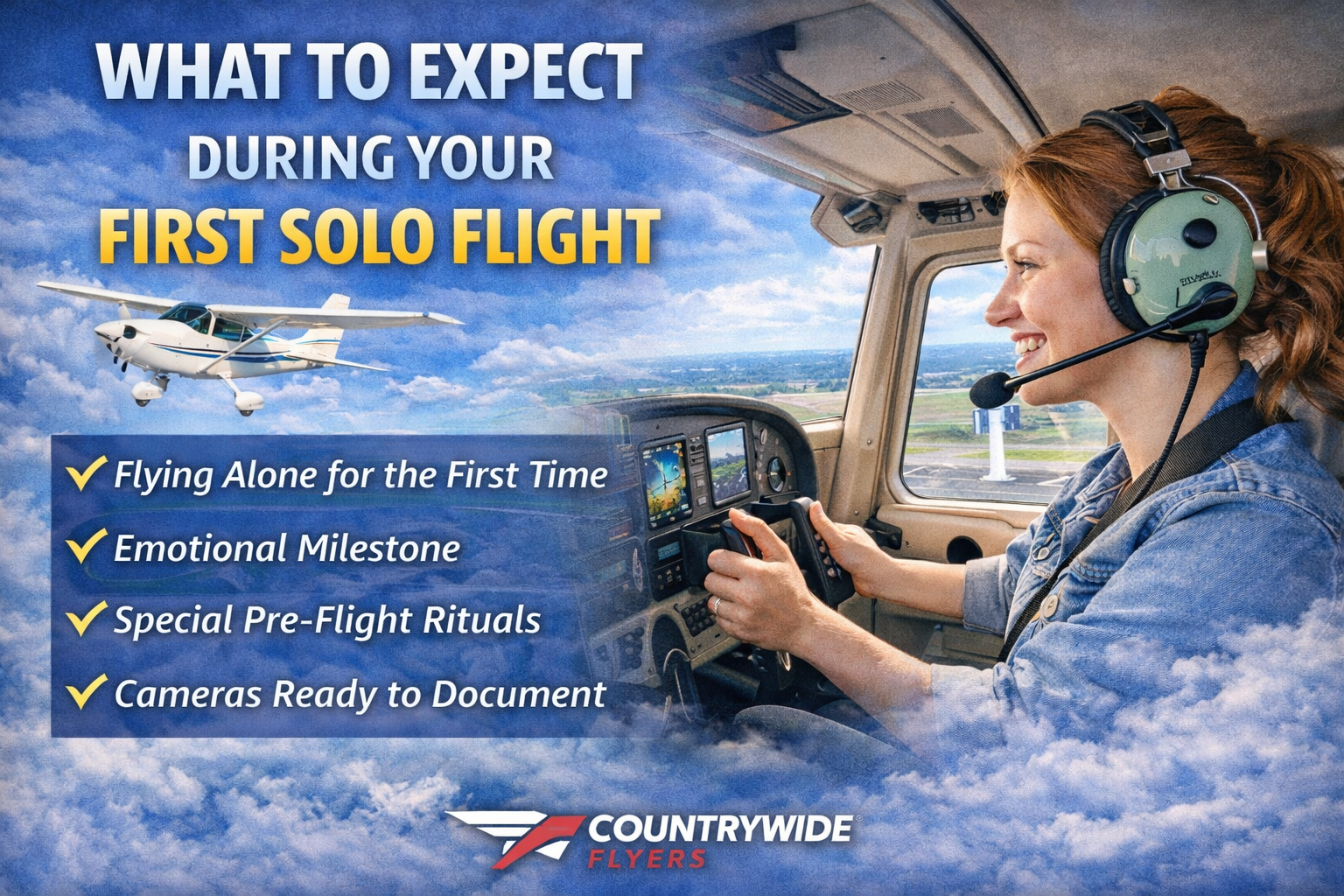
What to Expect During Your First Solo Flight
For every pilot, there is one moment that stands above almost every other milestone in their aviation journey: their first solo flight.
It’s the moment when your instructor steps out of the airplane, closes the door, and sends you off to fly the aircraft entirely on your own for the first time. No instructor sitting beside you. No one correcting your controls. Just you, the airplane, and the sky.
For student pilots working toward their Private Pilot License, the first solo is a defining milestone. It represents the moment when your instructor has enough confidence in your abilities to let you safely fly the aircraft alone.
At Countrywide Flyers in Apopka, we’ve watched countless student pilots experience this unforgettable moment at Orlando-Apopka Airport (X04). It’s a moment filled with excitement, pride, and sometimes a little bit of nervous energy.
If you’re currently learning to fly or thinking about becoming a pilot, you may be wondering exactly what to expect during your first solo flight.
In this guide, we’ll walk through everything you should know about this exciting aviation milestone.
What Is a First Solo Flight?
A first solo flight occurs when a student pilot flies an aircraft alone for the first time without a flight instructor onboard.
Before this moment happens, your instructor must determine that you are fully capable of safely operating the aircraft and handling the airport traffic pattern.
During your solo flight you will typically:
- Taxi the airplane
- Take off
- Fly the traffic pattern
- Land the aircraft
- Repeat the pattern several times
Your instructor will usually watch from the ground while communicating via radio.
While the flight may only last 10 to 20 minutes, it becomes one of the most memorable moments in a pilot’s life.
When Do Student Pilots Solo?
There is no fixed number of hours required before a student pilot can solo.
However, most students complete their first solo somewhere between:
10 and 20 flight hours
The exact timing depends on several factors:
- Student progress
- Training frequency
- Instructor judgment
- Airport conditions
Some students may solo earlier, while others may take longer. The important factor is that the student demonstrates consistent safety and control of the aircraft.
The Skills You Must Master Before Solo
Before your instructor allows you to fly solo, you must demonstrate strong proficiency in several key areas.
These skills ensure you can safely handle the airplane without assistance.
Takeoffs
You must demonstrate consistent, safe takeoffs including:
- Maintaining runway centerline
- Proper rotation speed
- Smooth climb-out
Takeoff control is essential for safe flight operations.
Landings
Landings are one of the most challenging skills in pilot training.
Before soloing, you must consistently demonstrate safe landings that include:
- Proper approach speed
- Correct glide path
- Smooth flare and touchdown
- Maintaining directional control
Your instructor must feel confident that you can land safely every time.
Traffic Pattern Operations
Most solo flights take place within the airport traffic pattern.
You must demonstrate that you understand:
- Pattern altitude
- Downwind, base, and final legs
- Proper spacing from other aircraft
- Radio communication procedures
Being comfortable in the traffic pattern is critical for safe solo operations.
Radio Communication
Student pilots must also demonstrate the ability to communicate effectively with other aircraft and air traffic control when necessary.
Clear communication ensures safe coordination with other pilots operating in the area.
Emergency Procedures
Before soloing, you must understand how to handle potential emergencies.
These include:
- Engine failure
- Go-around procedures
- Aborted takeoffs
Your instructor must know that you can remain calm and make safe decisions if something unexpected happens.
The Moment Your Instructor Says “You’re Ready”
For many students, the moment comes unexpectedly.
After several successful landings, your instructor may taxi back to the ramp and say something like:
“Pull over here for a moment.”
Then they’ll often say the words every student pilot remembers forever:
“You’re ready to solo.”
Your instructor will step out of the airplane and send you back to the runway alone.
At that moment, the reality of what you’re about to do finally sets in.
You’re about to fly an airplane by yourself.
Why the Airplane Feels Different During Solo
One of the first things many student pilots notice during their solo flight is that the airplane suddenly feels lighter.
That’s because the aircraft no longer has the weight of the instructor onboard.
The lighter weight means:
- Faster acceleration during takeoff
- Better climb performance
- Slightly different landing feel
Most students notice that the airplane climbs faster and responds more quickly to controls.
What the First Solo Flight Looks Like
Most first solo flights are intentionally simple.
Your instructor will usually have you perform three takeoffs and landings in the traffic pattern.
The sequence typically looks like this:
- Taxi to the runway
- Take off
- Fly the traffic pattern
- Land the aircraft
- Repeat two or three times
Your instructor will usually monitor the entire flight from the ground.
Even though you are flying solo, you are never truly alone.
The Emotions of Your First Solo Flight
Student pilots experience a wide range of emotions during their first solo.
These may include:
Excitement
Nervousness
Adrenaline
Confidence
Pride
Many pilots say the first solo flight is one of the most intense and memorable experiences of their lives.
The moment the wheels leave the runway and you realize you are flying the airplane alone is something you will remember forever.
The Tradition of Cutting the Shirt
After a student pilot completes their first solo flight, many flight schools and flying clubs participate in a long-standing aviation tradition.
The back of the student’s shirt is cut off and signed by their instructor.
This tradition dates back to the early days of aviation when instructors sat behind student pilots and would tug on the back of their shirts to get their attention.
Once the student could fly alone, the instructor was no longer needed behind them — so the shirt was cut off as a symbol of independence.
Many pilots proudly keep their solo shirt as a lifelong aviation memento.
Why the First Solo Is So Important
Your first solo flight represents much more than just flying alone.
It represents the moment when:
- Your instructor trusts your skills
- You gain confidence as a pilot
- You officially become a student pilot capable of independent flight
It’s a powerful milestone that marks the transition from beginner to real aviator.
What Happens After Your First Solo
After completing your solo flight, your training will continue with more advanced lessons.
These lessons may include:
- Solo practice flights
- Cross-country navigation
- Night flying
- Emergency training
Your solo flight is just the beginning of the next phase of your pilot training journey.
Why Orlando-Apopka Airport Is a Great Place for First Solos
Many student pilots perform their first solo at Orlando-Apopka Airport (X04).
This airport is ideal for pilot training because it offers:
- Manageable traffic levels
- Excellent practice areas nearby
- Friendly aviation community
- Convenient location near Orlando
These factors create an excellent learning environment for student pilots preparing for their first solo flight.
The First of Many Aviation Milestones
Your first solo is only the beginning of your aviation journey.
Future milestones will include:
- Your first cross-country flight
- Your first night flight
- Your Private Pilot License checkride
- Your first flight with passengers
Each milestone builds your skills and confidence as a pilot.
But your first solo flight will always hold a special place in your memory.
Start Your Pilot Journey at Countrywide Flyers
If you’ve ever dreamed about flying, your journey can begin right here in Central Florida.
At Countrywide Flyers in Apopka, aspiring pilots train in modern aircraft with experienced instructors while becoming part of a welcoming aviation community.
Our flying club provides:
- Professional flight instruction
- Access to quality training aircraft
- A supportive pilot community
- Incredible flying opportunities throughout Florida
Whether you want to fly recreationally or pursue a professional aviation career, our team is here to help you reach the skies.
Take Your First Step with a Discovery Flight
Every pilot’s journey begins with a first flight.
If you’ve ever wondered what it feels like to sit in the pilot’s seat and take the controls of an airplane, a Discovery Flight is the perfect way to begin.
to schedule your Discovery Flight and take the first step toward becoming a pilot.
Your first solo flight may be closer than you think.