10 Mistakes Student Pilots Make During Private Pilot Training
Learning to fly an airplane is one of the most rewarding challenges a person can take on. Earning a Private Pilot License (PPL) opens the door to incredible opportunities, from exploring new destinations to building a career in aviation.
However, the journey from student pilot to licensed aviator isn’t always smooth. Like any new skill, flight training comes with a learning curve, and many students encounter similar challenges along the way.
The good news is that most mistakes student pilots make are completely normal — and avoidable with the right mindset and preparation.
At Countrywide Flyers in Apopka, we work with student pilots at all stages of their training. Over time, instructors tend to see the same common mistakes appear again and again during private pilot training.
If you’re currently learning to fly or thinking about starting your aviation journey, understanding these common pitfalls can help you progress faster and become a safer, more confident pilot.
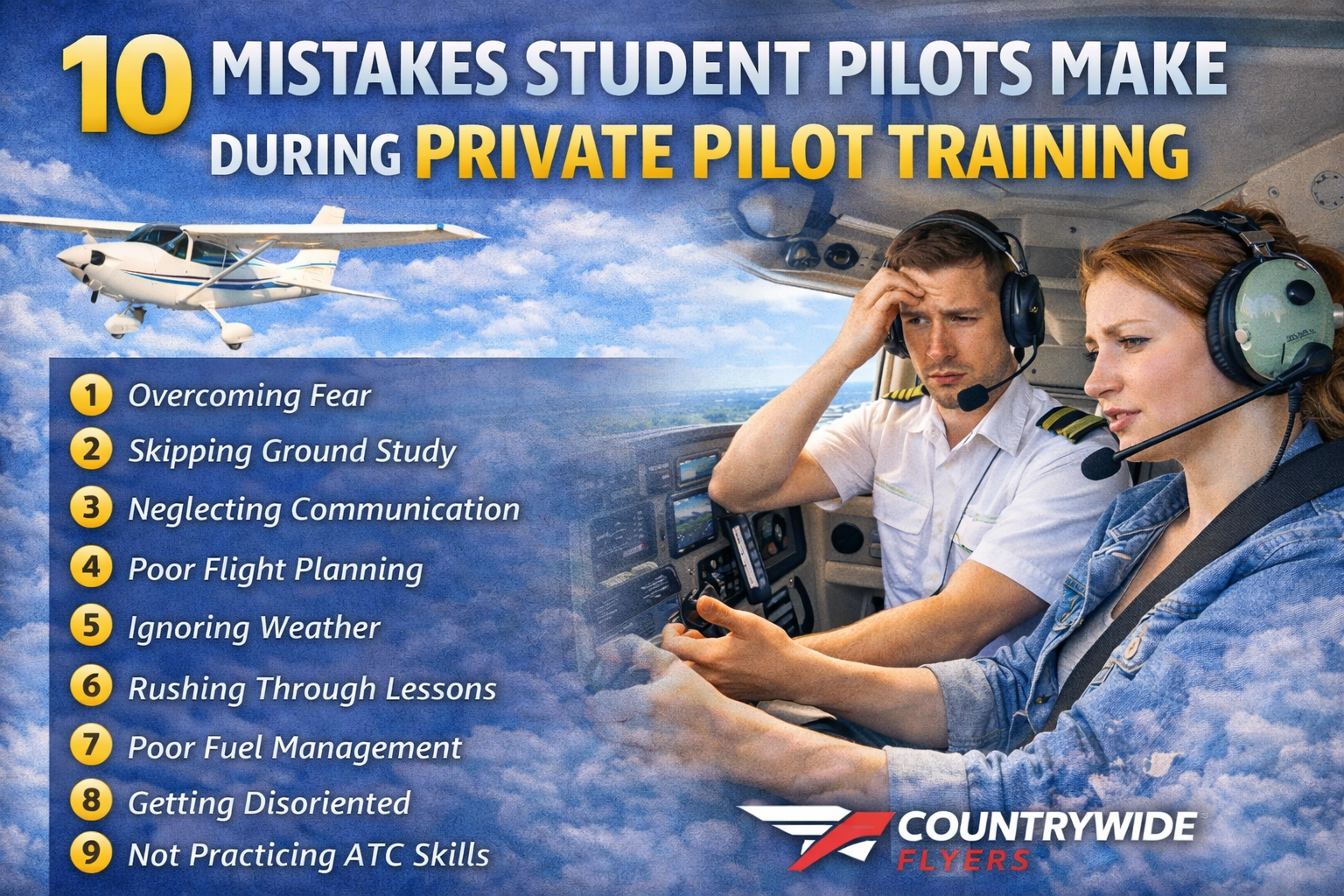
Here are 10 of the most common mistakes student pilots make during private pilot training — and how to avoid them.
1. Not Flying Often Enough
One of the biggest mistakes student pilots make is training too infrequently.
Flying requires muscle memory and skill development. When students wait too long between lessons, they often spend the next lesson relearning skills they had already mastered.
This slows progress and can increase training costs.
Ideal Training Frequency
Most instructors recommend flying:
2–3 times per week
This keeps skills fresh and helps students build confidence quickly.
Consistent training also helps reduce the total number of hours needed to complete the Private Pilot License.
2. Not Studying Ground Knowledge
Flying isn’t just about controlling the airplane. Pilots must also understand the theory behind aviation.
This includes knowledge of:
- Weather
- Aerodynamics
- Navigation
- FAA regulations
- Aircraft systems
Students who skip studying ground material often struggle to understand what is happening in the cockpit.
A good rule of thumb is to spend time studying between flight lessons.
Prepared students make faster progress and become better pilots.
3. Overcontrolling the Airplane
New pilots often try to make large or abrupt control movements when flying.
However, airplanes respond best to small, smooth inputs.
Overcontrolling can lead to:
- Altitude deviations
- Unstable approaches
- Difficult landings
One of the key lessons student pilots learn is that flying requires gentle control movements and patience.
A light touch on the controls usually produces the best results.
4. Fixating on the Instruments
Many beginner pilots spend too much time staring at the instrument panel.
While instruments are important, most visual flight training requires pilots to focus primarily outside the aircraft.
Looking outside helps pilots maintain:
- Proper pitch attitude
- Aircraft alignment
- Traffic awareness
Instructors often remind students that the primary flight instrument in visual flight conditions is the horizon.
Learning to balance outside scanning with instrument monitoring is an important skill.
5. Poor Radio Communication
Talking on the radio can be intimidating for new pilots.
Many student pilots worry about saying something incorrectly when communicating with air traffic control or other aircraft.
However, radio communication becomes easier with practice.
Common mistakes include:
- Talking too quickly
- Forgetting key information
- Hesitating before speaking
The best way to improve radio communication is simply to practice.
Listening to airport frequencies and studying common phraseology helps students build confidence.
6. Rushing Through Lessons
Some student pilots focus too much on finishing training quickly instead of mastering each skill along the way.
While it’s natural to want to earn your license as soon as possible, rushing can lead to gaps in knowledge and confidence.
Flight training should focus on developing strong fundamentals.
Students who take the time to fully understand each concept often become safer and more capable pilots.
Quality training is always more important than speed.
7. Ignoring Weather Conditions
Weather plays a critical role in aviation safety.
Student pilots must learn how to evaluate weather conditions before every flight.
Some students underestimate the importance of weather planning or rely too heavily on their instructor to make weather decisions.
Pilots must understand how to interpret:
- METAR reports
- TAF forecasts
- Radar imagery
- Wind conditions
Developing strong weather awareness early in training is essential for becoming a responsible pilot.
8. Not Using Checklists Properly
Checklists exist for a reason.
Even experienced airline pilots rely on checklists for every flight.
Student pilots sometimes attempt to memorize procedures instead of using the checklist.
However, skipping checklists can lead to important steps being missed.
Checklists help ensure that:
- Aircraft systems are configured correctly
- Safety procedures are followed
- Nothing important is forgotten
Developing strong checklist discipline early in training builds good habits that last throughout a pilot’s career.
9. Poor Flight Planning
Every flight requires preparation.
Before taking off, pilots must plan their route, fuel requirements, and navigation strategy.
Student pilots sometimes underestimate the importance of proper flight planning.
Key planning steps include:
- Reviewing weather
- Calculating fuel requirements
- Studying airport diagrams
- Reviewing airspace
Good planning reduces stress in the cockpit and allows pilots to focus on flying safely.
10. Losing Confidence After Mistakes
Perhaps the most common mistake student pilots make is becoming discouraged after making errors.
Learning to fly is challenging, and every pilot makes mistakes during training.
Even experienced pilots occasionally encounter difficult flights.
What matters most is learning from mistakes rather than becoming discouraged by them.
Every lesson — good or bad — helps pilots develop stronger skills and better decision-making abilities.
Confidence grows with experience.
The Truth About Pilot Training
One of the most important things for student pilots to remember is that mistakes are part of the learning process.
Every pilot who has ever earned a license has made errors during training.
The key is working with a good instructor who helps you learn from those experiences.
Over time, the challenges that once seemed difficult become second nature.
Landing an airplane, navigating cross-country flights, and communicating with air traffic control eventually become routine skills.
Tips for Success During Private Pilot Training
Student pilots who succeed in flight training often share several habits.
These include:
Fly Consistently
Regular training helps maintain momentum and build confidence.
Study Between Lessons
Reviewing ground material prepares you for the next lesson and helps reinforce concepts.
Ask Questions
Instructors are there to help you learn. Asking questions is one of the best ways to deepen your understanding.
Stay Positive
Flight training has ups and downs. Maintaining a positive mindset makes the process more enjoyable.
Focus on Safety
Safe decision-making should always be the top priority for every pilot.
Why Central Florida Is a Great Place to Learn to Fly
Central Florida is one of the best locations in the United States for flight training.
The region offers:
- Excellent year-round flying weather
- Numerous nearby airports
- Diverse airspace environments
- Beautiful scenery
These conditions allow student pilots to gain valuable experience while enjoying some of the most scenic flying in the country.
Learn to Fly with Countrywide Flyers
If you’re interested in earning your Private Pilot License in Central Florida, Countrywide Flyers in Apopka offers a welcoming environment for aspiring pilots.
Our flying club combines professional instruction with a strong aviation community, giving students the opportunity to learn in a supportive and enjoyable environment.
Members benefit from:
- Modern training aircraft
- Experienced instructors
- Flexible scheduling
- A community of passionate pilots
Whether your goal is recreational flying or a professional aviation career, our team can help you start your journey.
Start Your Pilot Journey with a Discovery Flight
Every pilot begins with their first flight.
A Discovery Flight allows you to sit in the pilot seat, take the controls, and experience what it feels like to fly an airplane.
If you’ve ever dreamed of becoming a pilot, this is the perfect first step.
Visit:
to schedule your Discovery Flight and start learning to fly today.
The sky is waiting.