Orlando Pilot Community
Inside the Orlando Pilot Community: Where Central Florida Aviators Fly, Gather, and Build a Life Around the Airplane
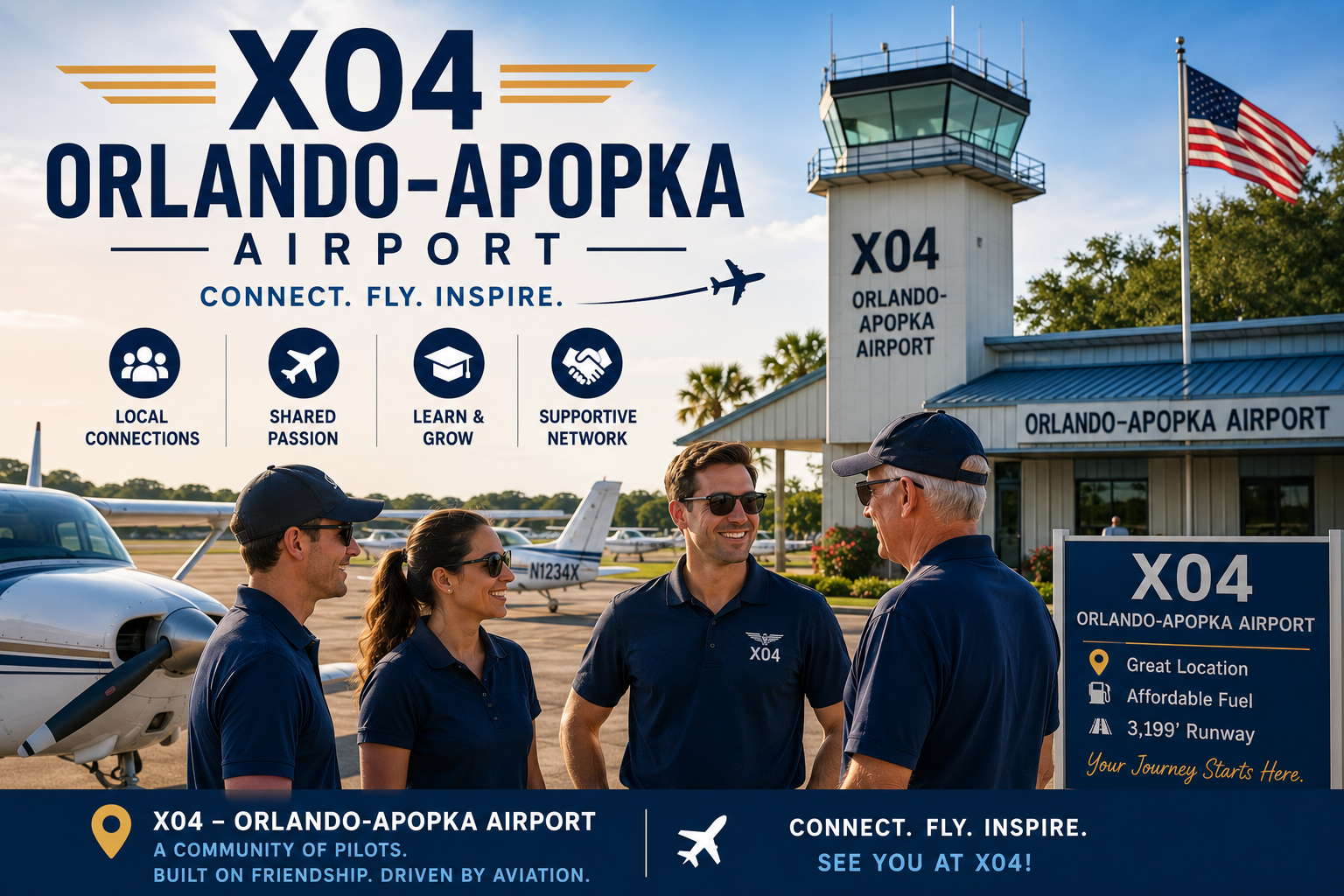
There’s a particular kind of conversation that happens on the ramp at Orlando-Apopka Airport on Saturday mornings. It starts with weather — always weather — moves through what someone’s been working on in their hangar, drifts into a story about a flight to Cedar Key that didn’t go as planned, and ends with someone saying “alright, I’m gonna go fly.”
You can’t manufacture that. You can’t buy it. You don’t get it from an app.
You get it from being part of a real pilot community — the kind of place where the same faces show up on the same ramp every weekend, where people know what airplane you fly, and where someone notices if you haven’t been around in a while.
Orlando, it turns out, is one of the best cities in the country to find this. Not because the marketing brochures say so, but because the underlying conditions — geography, weather, airport density, and a critical mass of aviation enthusiasts — happen to be exactly right. Central Florida has quietly built one of the strongest general aviation communities in the United States.
This post is a tour of that community: where the pilots actually fly, where they gather, what makes them stick around, and how to find your place in it.
Why Orlando Has One of America’s Strongest Pilot Communities
A pilot community isn’t built on hangar fans and FBO lobbies. It’s built on four things: enough airports to give pilots options, enough weather to give them flight days, enough variety of flying to keep them engaged, and enough other pilots to give them company.
Orlando has all four in unusual abundance.
Airports. Within an hour’s drive of downtown Orlando, you’ve got Apopka (X04), Orlando Executive (KORL), Kissimmee Gateway (KISM), Orlando Sanford (KSFB), Leesburg (KLEE), Bartow (KBOW), Lakeland Linder (KLAL), Ocala (KOCF), Spruce Creek (7FL6), and a handful of smaller fields. That’s an aviation infrastructure that genuinely rivals any metro area in the country.
Weather. While Midwest and Northeast pilots lose months to winter, Central Florida pilots fly year-round. The afternoon thunderstorms of summer are real and demand respect, but morning operations are some of the smoothest in the country. The pilots who learn to read Florida weather get more flying days per year than almost anyone else in American aviation.
Variety of flying. From the uncongested ramp at Apopka to the Class B transitions at MCO to the long over-water legs to the Keys, Orlando pilots see everything. Beach landings, lake flying, formation work, IFR in actual conditions, fly-out destinations from Cedar Key to Key West to the Bahamas — all within reach of a single afternoon.
Critical mass. Central Florida is home to thousands of active pilots. UCF and Embry-Riddle pipeline new aviators in constantly. Retired airline captains, military aviators, working CFIs, weekend warriors, aircraft owners, and student pilots all live within the same airspace. The result is one of the densest concentrations of GA enthusiasts in America.
Put those four ingredients together and you don’t have a flying scene. You have a community.
Who’s in the Orlando Pilot Community?
If you go looking for the Orlando pilot community in one place, you won’t find it. It’s not a building. It’s a network spread across a dozen airports and as many subcultures, including:
The Apopka X04 crowd. Friendly, non-towered, low-key. The people who fly out of X04 are typically working pilots and weekend aviators who picked the airport because it’s affordable, uncrowded, and feels like a real general aviation field. The community here is tight. People know each other.
The Orlando Executive (KORL) regulars. Closer to downtown, more business aviation, more high-performance singles and light twins. A more transactional feel than X04, but a real community of working professionals who use their airplanes for actual transportation.
The Sanford (KSFB) flight-school students. Sanford is dominated by the big career-track schools — Epic, Aerosim Flight Academy, and others. The community here skews younger and more career-focused. Lots of foreign student pilots. Different energy than X04, but absolutely a community of its own.
The Lakeland (KLAL) Sun ‘n Fun universe. Lakeland Linder hosts Sun ‘n Fun, the second-largest annual aviation event in the world (after Oshkosh). The pilots who orbit around KLAL — many of them experimental aircraft builders, vintage warbird owners, and serious aviation enthusiasts — are some of the most knowledgeable in the country.
The university programs. UCF, Embry-Riddle Daytona, and Florida Tech all pipeline young pilots into the Central Florida ecosystem. Many stay after graduation. Many start flying clubs of their own. See our UCF Student Pilot Program for one of the on-ramps.
The Spruce Creek (7FL6) airpark community. Spruce Creek, just south of Daytona, is one of the largest residential fly-in communities in the world — over 5,000 residents and a runway running through the neighborhood. The culture there is its own thing entirely.
The military and airline retirees. Central Florida is a magnet for retired military aviators and airline captains. Many keep their hand in by flying personally, instructing part-time, or mentoring new pilots. If you spend enough time at any Central Florida airport, you’ll meet former F-16 drivers, retired 747 captains, and Vietnam-era helicopter pilots casually swapping stories at the picnic table.
The flying clubs. The connective tissue. Flying clubs — including Countrywide Flyers — give pilots a home base, shared aircraft, regular events, and the steady human contact that turns “people who fly” into “a community of pilots.”
Where the Community Actually Gathers
Online forums are fine. Group texts are fine. But the Orlando pilot community is built mostly in person, in a handful of recurring places:
Saturday morning ramps. This is the bedrock. At X04, KORL, KISM, KOCF, and a dozen other Central Florida airports, the same pilots show up on the same weekends. Some are flying. Some are working on airplanes. Some are just leaning on a wing drinking coffee. This is where the community actually exists.
Fly-in breakfasts and lunches. Pancake breakfasts at EAA chapter hangars. Saturday lunches at the on-field restaurants at Bartow, Sebring, and a few of the smaller fields around the state. These aren’t formal events — they’re traditions. Show up, eat, talk, fly home.
EAA chapter meetings. The Experimental Aircraft Association runs local chapters across Central Florida. Monthly meetings. Build projects. Young Eagles flights for kids. Some of the most engaged aviation people you’ll meet are working through an EAA chapter.
AOPA fly-ins and regional events. AOPA runs national fly-ins that frequently land in Central Florida. Free for AOPA members. Massive turnout. Great way to meet pilots from outside your usual circle.
Sun ‘n Fun (Lakeland, April). The biggest annual gathering in Central Florida aviation. If you fly anywhere in this region, you go at least once. Many pilots go every year.
Aircraft owners’ associations. Cessna Pilots Association, American Bonanza Society, Mooney Owners — these national groups all have regional members who meet locally for type-specific events.
Flying club socials. Most flying clubs run regular events for members — fly-outs, hangar parties, holiday gatherings, fly-in lunches. The club calendar becomes the infrastructure that keeps casual pilots connected.
Why a Flying Club Matters More Than People Realize
Most pilots think of a flying club as an aircraft access solution. Lower hourly rates, no down payment, no maintenance headaches. All true.
But the deeper value — the thing that keeps people flying for 20 or 30 years instead of dropping out after 3 — is the community itself.
Here’s the unspoken statistic about American general aviation: most pilots stop flying within 5 years of earning their license. It’s not because they fall out of love with aviation. It’s because they lose connection to it. Without other pilots in their life, flying becomes a thing they used to do.
A flying club inverts that. When you’re a member of a club like Countrywide Flyers, you’re not just renting an airplane. You’re showing up at the same hangar as the same people every week. You’re going on fly-outs with members you’ve gotten to know. You’re trading tips on airports, recommending CFIs, sharing weather wisdom, and slowly building a network of friendships you didn’t know aviation could give you.
That’s the difference between being a pilot and being part of a pilot community.
Independent CFIs: The Other Heartbeat of the Community
One of the quieter but most important parts of the Orlando pilot community is the network of independent FAA-certified flight instructors working across Central Florida. These are the CFIs who didn’t go the major flight-school route — they operate independently, often out of co-op clubs like Countrywide Flyers, and they build long-term relationships with the students they train.
This matters for the community because independent CFIs:
- Train pilots who stay in the area after their checkride (unlike career pipeline schools where many students leave Florida the day they hit ATP mins)
- Mentor pilots through ratings beyond the PPL — instrument, commercial, CFI
- Become part of the local social fabric in a way that big-school instructors usually don’t
- Tend to fly more themselves, build hours, share knowledge
If you’re looking to plug into the Orlando pilot community, finding the right independent CFI is one of the most powerful single moves you can make. They know everyone. They’ve trained dozens of pilots in the area. They’ll plug you into the network faster than any other entry point. See our page on connecting with FAA-certified flight instructors.
How to Find Your Place in the Orlando Pilot Community
Whether you’re already a pilot or you’re still working on your license, the path into the community is more accessible than people assume. A few practical entry points:
If you’re a current pilot:
- Pick a home airport. Pick the field that fits your style — X04 if you like uncongested non-towered, KORL if you want urban convenience, KISM or KSFB if you want Class D experience. Then go there on weekends, not just to fly.
- Join a flying club. Even if you own your own airplane, club membership plugs you into events, fly-outs, and the social fabric.
- Join AOPA and EAA. Both have active local chapters. EAA’s local chapter meetings are where some of the most interesting people in Central Florida aviation hang out.
- Pick a regular fly-out destination. Become a regular at one of the fly-in restaurants. Pilots see you, you see them, conversations happen.
- Show up at Sun ‘n Fun. If you only do one aviation event in Central Florida, this is it.
If you’re not a pilot yet:
- Book a Discovery Flight. This is the entry point. One 90-minute introductory flight at X04 will tell you whether aviation is for you, and whether you want to plug into this world.
- Visit a fly-in breakfast as a passenger. Watch the community happen. Pilots are universally friendly to non-pilots who are interested in aviation — bring your kids, bring questions, bring an appetite.
- Start flight training with an independent CFI through a club like Countrywide Flyers. You’ll be part of the community before you even solo.
The Orlando pilot community isn’t gated. Nobody’s looking for credentials. The only requirement is that you actually show up.
Frequently Asked Questions
Where do most pilots in Orlando hang out? The Orlando pilot community is distributed across roughly a dozen Central Florida airports, with Apopka (X04), Orlando Executive (KORL), Kissimmee Gateway (KISM), Orlando Sanford (KSFB), Lakeland Linder (KLAL), and Spruce Creek (7FL6) being the most active. On weekends, the ramps at these airports become informal gathering spots for working pilots, aircraft owners, and flight students.
Are there flying clubs in Orlando worth joining? Yes. Central Florida has several active flying clubs catering to different pilot profiles. Countrywide Flyers, based at Apopka X04, operates as a membership-based cooperative where pilots connect with independent FAA-certified instructors and rent aircraft at member rates. For a comparison of club versus flight-school models, see Flying Club vs. ATP/Epic/Aerosim Orlando.
What aviation events happen in Central Florida? Sun ‘n Fun at Lakeland Linder (KLAL) in April is the largest annual event — the second-biggest aviation gathering in the world. Beyond that, EAA chapters across Central Florida run monthly meetings, AOPA hosts periodic regional fly-ins, and most local airports run their own breakfast or lunch fly-in events through the year. Local flying clubs run member events on roughly monthly cadence.
How do I meet other pilots in Orlando? Start by picking an airport and showing up regularly on weekends. Join a flying club. Attend at least one EAA chapter meeting. Go to a fly-in breakfast as a guest. Train with an independent CFI rather than a large school — independent instructors are deeply networked into the local community and will introduce you naturally.
Is the Orlando pilot community welcoming to new pilots? Without exception. American general aviation as a culture is welcoming to anyone interested, and the Orlando community is one of the more open versions of that. The unwritten rule is simple: show up, ask questions, and listen. Pilots love talking about flying with people who actually want to hear it.
What if I’m interested in aviation but haven’t started training yet? Book a Discovery Flight at Apopka X04. It’s the most direct way to find out whether flying is for you and whether you want to become part of this community. Most pilots in the Orlando area can trace their entire flying career back to a single 90-minute introductory flight.
Does Countrywide Flyers operate as a flight school? No. Countrywide Flyers is a membership-based co-op flying club. Flight instruction is conducted independently between members and FAA-certified instructors operating out of X04. The co-op model is part of what makes the community what it is — instructors choose to teach there because they want to be there, members choose to train there because they want a community rather than a customer relationship, and the result is a tighter group than you’ll find at most traditional schools.
The Bottom Line
The Orlando pilot community isn’t a club, an organization, or a website. It’s a slow-built thing made out of weekend ramps, fly-in breakfasts, hangar conversations, fly-outs to Cedar Key, mentorships that last for decades, and the quiet decision — made by thousands of Central Florida pilots over the years — to keep showing up.
If you fly, this community is one of the best reasons to live in Central Florida.
If you don’t fly yet but you’ve been thinking about it, this community is one of the best reasons to start.
Ready to Plug In?
📍 Countrywide Flyers · Hangar 39 · Orlando-Apopka Airport (X04) 1321 Apopka Airport Rd, Apopka, FL 32712 ☎️ 877-277-1188 · ✉️ info@countrywideflyers.com
Book a Discovery Flight · Apply for Membership · Connect with a CFI
Countrywide Flyers Cooperative Association is a membership-based flying club. We do not provide flight instruction, aircraft rental to the public, or operate as a flight school. All flight training is conducted independently between members and FAA-certified flight instructors. Flight instruction is available only to active members of the cooperative association.