How to Log 1,500 Hours for the Airlines in Florida
If your goal is to fly for the airlines, there is one number that stands between you and the right seat of a regional jet:
1,500 hours.
For most civilian pilots in the United States, 1,500 total flight hours is the minimum required to obtain an Airline Transport Pilot (ATP) certificate — the credential required to fly for Part 121 airlines.
To many aspiring pilots, that number feels massive.
But here’s the truth:
If you train strategically — especially in Florida — 1,500 hours is not only achievable, it is predictable.
Florida is one of the best states in the country to build flight time efficiently, consistently, and affordably. With year-round flyable weather, dense airspace, strong training infrastructure, and active general aviation communities, it creates the ideal environment for career pilots.
In this edition of The Crosswind Chronicles, we’re breaking down:
- The 1,500-hour rule explained
- Why Florida is a strategic advantage
- The fastest and smartest ways to build time
- A realistic timeline from zero to airline-ready
- Common mistakes that slow pilots down
- And how to take your first step toward the airlines
If you’re serious about becoming an airline pilot in Florida, this is your roadmap.
Understanding the 1,500-Hour Rule (ATP Requirements Explained)
To fly for a U.S. airline under Part 121 operations, you must hold an Airline Transport Pilot (ATP) certificate.
For most civilian pilots, that requires:
- 1,500 hours total time
- 500 hours cross-country
- 100 hours night
- 75 hours instrument
- 250 hours Pilot in Command (PIC)
- 50 hours multi-engine (recommended, not always required but highly competitive)
There are restricted ATP (R-ATP) pathways for military pilots and certain university graduates, but for most pilots training through a flying club or Part 61 school in Florida, the standard 1,500-hour requirement applies.
The key realization?
These hours are not just a number.
They represent experience, exposure, weather decision-making, radio proficiency, and real-world aviation maturity.
Why Florida Is One of the Best States to Build 1,500 Hours
If you were designing the perfect state to build flight time, you would likely build something very close to Florida.
1. Year-Round Flying Weather
One of the biggest obstacles for pilots in northern states is weather.
- Snow
- Icing
- Low ceilings
- Months of winter cancellations
In Florida, you can realistically fly year-round.
Even during summer thunderstorm season, mornings and late afternoons remain highly flyable. Winters are mild and offer some of the best VFR days of the year.
More flyable days = more logged hours.
This alone can shorten your timeline to 1,500 hours by months compared to training in colder climates.
2. Diverse and Complex Airspace
Florida offers a rare mix of:
- Class B airspace (Orlando, Miami, Tampa)
- Class C airspace (Daytona, Jacksonville, Sarasota)
- Class D airports
- Busy non-towered training fields
- Military airspace corridors
- Coastal and overwater routes
This environment forces radio discipline, situational awareness, and workload management — exactly the skills airlines look for.
If you train out of Apopka (X04) with Countrywide Flyers, you are strategically positioned just outside Orlando Class B airspace. That means you gain exposure to complex airspace without being stuck in constant departure delays.
👉 Internal Link Suggestion: Link “Apopka (X04)” to your Airport/About page.
👉 Internal Link Suggestion: Link “Countrywide Flyers” to your Membership page.
3. Cross-Country Goldmine
To reach 1,500 hours, you need substantial cross-country time.
Florida provides:
- North–South runs across the peninsula
- Coastal flying along the Atlantic and Gulf
- Overwater experience to the Florida Keys
- Quick state-border hops to Georgia and Alabama
You can stack meaningful cross-country time without extreme fuel stops or repositioning.
That efficiency matters.
The Step-by-Step Path to 1,500 Hours in Florida
Let’s break down the realistic pathway.
Step 1: Private Pilot License (PPL)
Your Private Pilot License is your foundation.
Average hours at completion: 55–75 hours
Timeline (focused training): 3–4 months
Key Tip: Fly 3–5 times per week. Momentum is everything.
👉 Internal Link Suggestion: Link “Discovery Flight” here to your Discovery Flight booking page.
Step 2: Instrument Rating
Your Instrument Rating is what separates hobby pilots from serious career pilots.
Average hours added: 40–60 hours
Timeline: 2–3 months
Florida’s afternoon weather and summer convection actually become training advantages. You will see real-world weather systems early in your development.
Airlines expect strong IFR proficiency.
Step 3: Commercial Pilot License
At 250 total hours, you can pursue your Commercial certificate.
This is where you transition from “learning to fly” to “learning to operate.”
You will refine:
- Precision maneuvers
- Systems knowledge
- Risk management
- Professional cockpit discipline
Timeline: 2–3 months after Instrument.
Step 4: Certified Flight Instructor (CFI)
If you want to reach 1,500 hours efficiently, this is your launchpad.
Becoming a CFI allows you to:
- Log dual given
- Build PIC time
- Get paid to fly
- Build leadership skills
In Florida, instructors at busy clubs or schools can log:
60–100 hours per month.
At 80 hours per month:
1,000 hours = 12–14 months
1,500 hours = 18–24 months
That means you can realistically go from zero to airline minimums in 3–4 years with focus and consistency.
Why Instructing Is the Most Reliable Hour-Building Strategy
There are other time-building methods — but instructing remains the gold standard.
Why?
- High volume
- Loggable PIC
- Resume strength
- Consistent schedule
- Airline-preferred background
Florida’s dense student population creates constant demand for instructors.
When you train in an active aviation ecosystem, opportunities multiply.
Building Multi-Engine Time in Florida
Airlines don’t just look at total time — they look at quality.
Multi-engine time matters.
Ways to build multi-engine hours:
- Earn your MEI
- Conduct multi training
- Split time with other instructors
- Join a club with multi availability
Even 50–100 hours of multi-engine time significantly strengthens your application.
👉 Internal Link Suggestion: Link to your Fleet page if you add a multi-engine aircraft.
Alternative Hour-Building Jobs in Florida
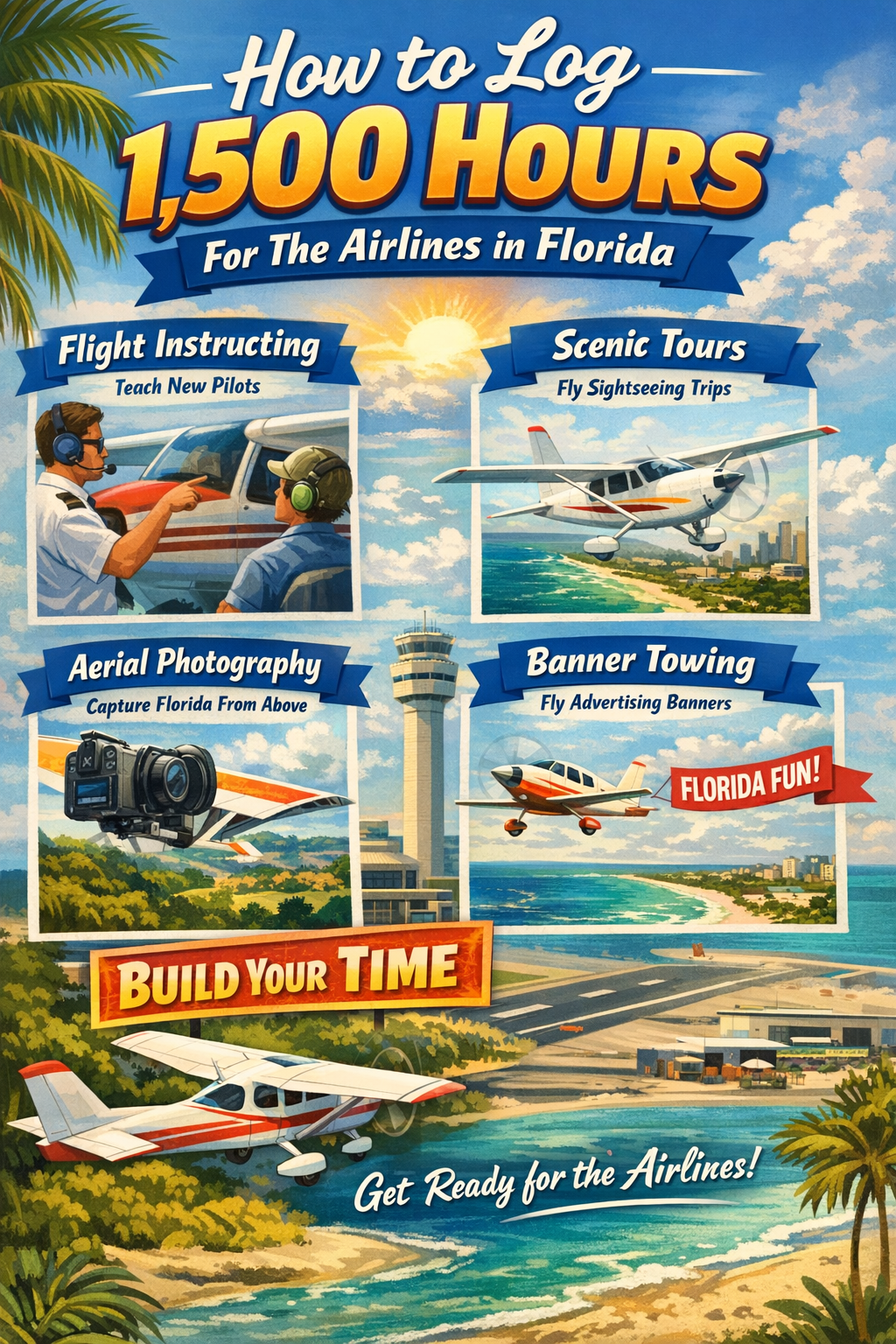
While instructing is the most common path, Florida offers additional opportunities:
Banner Towing
High volume coastal hours.
Aerial Survey
Long cross-country missions.
Skydiving Operations
Weekend-heavy but steady.
Pipeline Patrol
Low-level, high-focus flying.
Ferry Flights
Inconsistent but valuable.
Florida’s aviation economy supports all of these roles.
A Realistic Timeline: Zero to Airline Cockpit
Let’s build a conservative example.
Year 1
Private + Instrument + Commercial
~250 hours
Year 2
CFI + Full-time instructing
~800–1,000 hours
Year 3
Continue instructing
~1,500 hours
Total timeline: 36–48 months.
Consistency is everything.
Common Mistakes That Delay 1,500 Hours
- Training part-time without structure
- Long breaks between ratings
- Avoiding CFI
- Not networking
- Ignoring multi-engine time
- Waiting too long to apply
Momentum compounds.
What Airlines Actually Care About
Airlines evaluate:
- Total time
- Multi-engine time
- Checkride history
- Professionalism
- Communication skills
- Consistency
They do not care if you trained Part 61 or Part 141.
They care about quality experience.
The Financial Reality (And Why It Still Makes Sense)
Flight training in Florida to CFI level may cost:
$65,000–$90,000 depending on efficiency.
But regional airline pay has improved dramatically in recent years.
With signing bonuses and increased pay scales, the long-term ROI remains strong.
This is not a short-term play. It’s a career decision.
Why a Flying Club Can Be a Strategic Advantage
A structured flying club environment like Countrywide Flyers offers:
- Lower hourly aircraft cost
- Flexible scheduling
- Community mentorship
- Cross-country partnerships
- Consistent access to aircraft
This reduces downtime and increases flying frequency — the two biggest variables in reaching 1,500 efficiently.
👉 Internal Link Suggestion: Link “Membership Application – Apply for Takeoff” here.
The Mental Game of 1,500 Hours
Logging 1,500 hours isn’t glamorous.
It’s:
- Early mornings
- Florida heat
- Lesson planning
- Student challenges
- Weather calls
- Consistent professionalism
The pilots who reach the airlines are the ones who show up when it’s hard.
Is the Airline Career Path Still Worth It in Florida?
Yes.
Airline hiring cycles fluctuate — but long-term demand remains strong.
Mandatory retirements and industry growth continue to create opportunity.
Florida remains one of the most efficient environments in the country to build time.
Your First Step: It Starts With One Flight
You don’t begin your airline career at 1,500 hours.
You begin with your first takeoff.
If you’re reading this and wondering whether aviation is the right path, the smartest next move is simple:
Take a Discovery Flight.
A Discovery Flight allows you to:
- Sit in the left seat
- Take the controls
- Experience real-world airspace
- Talk with instructors about career planning
- See if aviation truly fits you
There is no better way to evaluate your future than being in the cockpit.
✈️ Ready to Start Logging Hours?
If your goal is to reach 1,500 hours and fly for the airlines in Florida, your journey starts now.
At Countrywide Flyers, we are building more than a flying club.
We are building:
- A community
- A mentorship network
- A structured training pathway
- A fleet that continues to grow
- Monthly aviation events and professional networking
Whether you are starting at zero or already building hours, we can help you take the next step.
👉 Book Your Discovery Flight Today
Feel the controls.
See the airspace.
Meet the community.
Start your logbook.
Click here to schedule your Discovery Flight and begin your path to 1,500 hours.
Fly More. Fly Better. Fly Together.