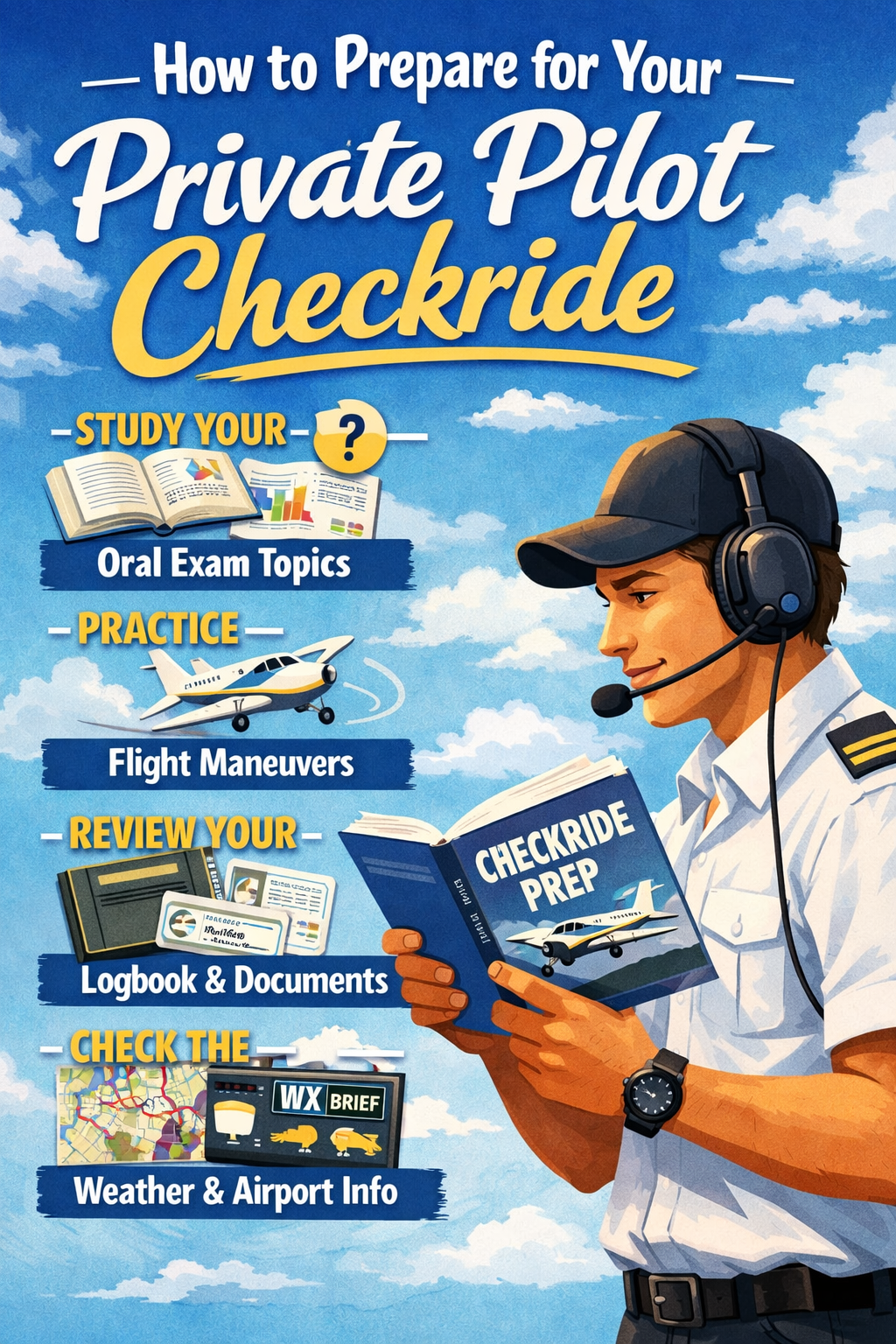
How to Prepare for Your Private Pilot Checkride
If you’re reading this, you’re close.
You’ve put in the hours.
You’ve survived steep turns, short fields, power-off stalls, crosswind landings, and more pattern work than you ever imagined.
Now one thing stands between you and your certificate:
The Private Pilot Checkride.
For many student pilots, the checkride feels intimidating. But here’s the truth:
The checkride isn’t designed to trick you.
It’s designed to confirm you are safe, competent, and ready.
In this guide, we’ll break down:
- What the Private Pilot Checkride actually includes
- How to prepare for the oral exam
- How to prepare for the flight portion
- Common mistakes that cause failures
- What examiners are really looking for
- A practical 30-day preparation plan
If you’re training in Florida — especially in busy Central Florida airspace — this guide will help you walk into your checkride confident and ready.
What Is the Private Pilot Checkride?
The Private Pilot Checkride is the final practical test required to earn your FAA Private Pilot Certificate under Part 61 or Part 141.
It consists of two major parts:
- The Oral Exam
- The Flight Portion
Both are conducted by a Designated Pilot Examiner (DPE).
The examiner is not your enemy.
Their job is to verify that you meet the standards outlined in the Airman Certification Standards (ACS) for Private Pilot Airplane.
Understanding the ACS (Your Blueprint to Pass)
If you want to prepare properly, everything starts with the ACS.
The Private Pilot ACS outlines:
- Knowledge areas
- Risk management elements
- Required skills
- Tolerances for maneuvers
Your checkride will follow this document almost exactly.
If you don’t already have a printed copy highlighted and tabbed — start there.
How to Prepare for the Private Pilot Oral Exam
The oral exam often causes more stress than the flight.
Why?
Because it can last 1.5 to 3 hours, depending on the examiner.
But here’s the secret:
It’s not a trivia contest.
It’s scenario-based decision making.
What the Oral Covers
Expect topics like:
- Airspace
- Weather interpretation
- Aircraft systems
- Performance calculations
- Weight & balance
- Cross-country planning
- FAR regulations
- Emergency procedures
- ADM (Aeronautical Decision Making)
The examiner may give you a cross-country scenario and ask:
“You planned to fly from Apopka to Jacksonville. The weather changes. What do you do?”
They want to see judgment — not memorization.
Best Strategy to Prepare for the Oral
1. Teach It Out Loud
If you can explain it clearly, you understand it.
Sit down with another pilot or instructor and:
- Explain airspace
- Explain weather minimums
- Explain how your pitot-static system works
- Explain how to calculate takeoff distance
If you hesitate, review that topic.
2. Know Your Aircraft Cold
You must know:
- Engine type
- Fuel capacity
- Oil type and quantity
- V-speeds
- Electrical system
- Required inspections
If you’re flying a Cessna 172 like N21754, you should know:
- What oil it uses
- Normal operating range
- Alternator vs battery function
- What happens during a vacuum failure
The examiner may ask:
“What would you do if your alternator failed in flight?”
They want logical troubleshooting.
3. Master Weather Interpretation
Especially in Florida, weather is critical.
Be prepared to interpret:
- METARs
- TAFs
- Radar imagery
- NOTAMs
- Surface analysis charts
Florida checkrides often include convective weather discussions.
Know how to identify:
- Thunderstorm risks
- Sea breeze effects
- Density altitude impacts
How to Prepare for the Flight Portion
The flight portion is usually 1.5–2 hours.
It will include:
- Preflight inspection
- Takeoff
- Basic maneuvers
- Ground reference maneuvers
- Slow flight
- Stalls
- Emergency procedures
- Diversion
- Short-field landing
- Soft-field landing
The examiner is evaluating:
- Aircraft control
- Situational awareness
- Risk management
- Checklist usage
- Communication
- Decision making
Not perfection.
Tolerances You Must Know
For example:
- Altitude: ±100 feet
- Heading: ±10 degrees
- Airspeed: ±10 knots
If you briefly exceed tolerances but correct smoothly, that’s fine.
If you chase the airplane aggressively, that’s not fine.
Common Private Pilot Checkride Mistakes
Let’s talk about what actually causes failures.
1. Poor Risk Management
Examiners fail applicants for:
- Ignoring weather concerns
- Press-on-itis
- Fuel mismanagement
- Not catching obvious red flags
Safety mindset matters more than stick-and-rudder perfection.
2. Weak Ground Knowledge
If you cannot explain:
- Airspace requirements
- Basic systems
- Performance calculations
You’re not ready.
3. Lack of Checklist Discipline
Use your checklist.
Verbalize flows.
Stay structured.
4. Unstable Approaches
In Florida’s busy training airports, stabilized approaches are critical.
If you’re high, fast, or unstable:
Go around.
Examiners love go-arounds.
30-Day Checkride Preparation Plan
Here’s a practical timeline.
30 Days Out
- Start oral prep daily
- Fly 2–3 times per week
- Begin mock oral with instructor
- Review ACS line by line
21 Days Out
- Practice full mock checkride flight
- Focus on weak maneuvers
- Review cross-country planning
14 Days Out
- Complete 1–2 full mock orals
- Tighten up airspace knowledge
- Drill weather interpretation
7 Days Out
- Light flight review
- Focus on confidence
- Chair-fly maneuvers
- Rest properly
Day Before
- Review paperwork
- Confirm endorsements
- Check logbook entries
- Get good sleep
- Hydrate
What Examiners Actually Want
They want to see:
- You are safe
- You make conservative decisions
- You can handle unexpected situations
- You know when to say no
- You understand your limitations
They do not expect you to fly like a commercial pilot.
They expect you to fly like a responsible Private Pilot.
Florida-Specific Checkride Considerations
If you’re training in Central Florida:
- Expect busy radio traffic
- Be ready for Class B discussion
- Know sea breeze patterns
- Prepare for density altitude questions in summer
If you train near Orlando, Tampa, or Jacksonville, your airspace knowledge must be sharp.
Mental Preparation Is Just as Important
The checkride is as much psychological as technical.
Confidence comes from preparation.
Remember:
Your instructor would not endorse you if you weren’t ready.
You’ve already proven competence dozens of times.
The checkride is just one more flight.
The Morning of Your Checkride
Arrive early.
Dress professionally.
Bring organized paperwork.
Stay calm.
If you make a small mistake:
Recover professionally.
Examiners care about recovery.
If Something Goes Wrong
You can discontinue for:
- Weather
- Aircraft issues
- Fatigue
You can retest specific areas if needed.
One mistake does not define you.
Professionalism does.
After You Pass
You’ll receive a temporary certificate.
You are now a Private Pilot.
You can:
- Carry passengers
- Fly day and night VFR
- Continue training
- Begin your instrument rating
And if your goal is the airlines?
This is only the beginning.
Final Thoughts
Preparing for your Private Pilot Checkride isn’t about cramming.
It’s about consistency.
Know the ACS.
Understand your airplane.
Think like a safe pilot.
Practice decision making.
If you do those things, you will pass.
And when you taxi back after that final landing and the examiner says:
“Congratulations.”
You’ll know every early morning and every crosswind landing was worth it.